
QC Score
Per-residue interaction energy decomposition for protein-ligand complexes. Know which atoms drive binding, what physics is responsible, and where your next modification should go.
%201.png)
Know Which Atoms Drive Binding and Why
QC Score computes per-residue interaction energies within the full electronic environment of the binding site. InteractionMap then decomposes each contact into electrostatics, dispersion, exchange-repulsion, and induction using symmetry-adapted perturbation theory. Together, they give you the resolution to see that a PEG linker fragment in a PROTAC contributes more dispersion energy than the warhead itself, or that a specific amide region is the sole electrostatic anchor at a protein interface.
Performance at a glance
minutes per typical drug-like ligand
ligands in parallel
hour for 1000 ligands
parameter-free
Accuracy that holds up against standard benchmarks
Competitive R-squared values across JAK1, CHK1, CDK2, and other standard benchmark datasets. Fully ab initio, completed in minutes, with no parameterization required.
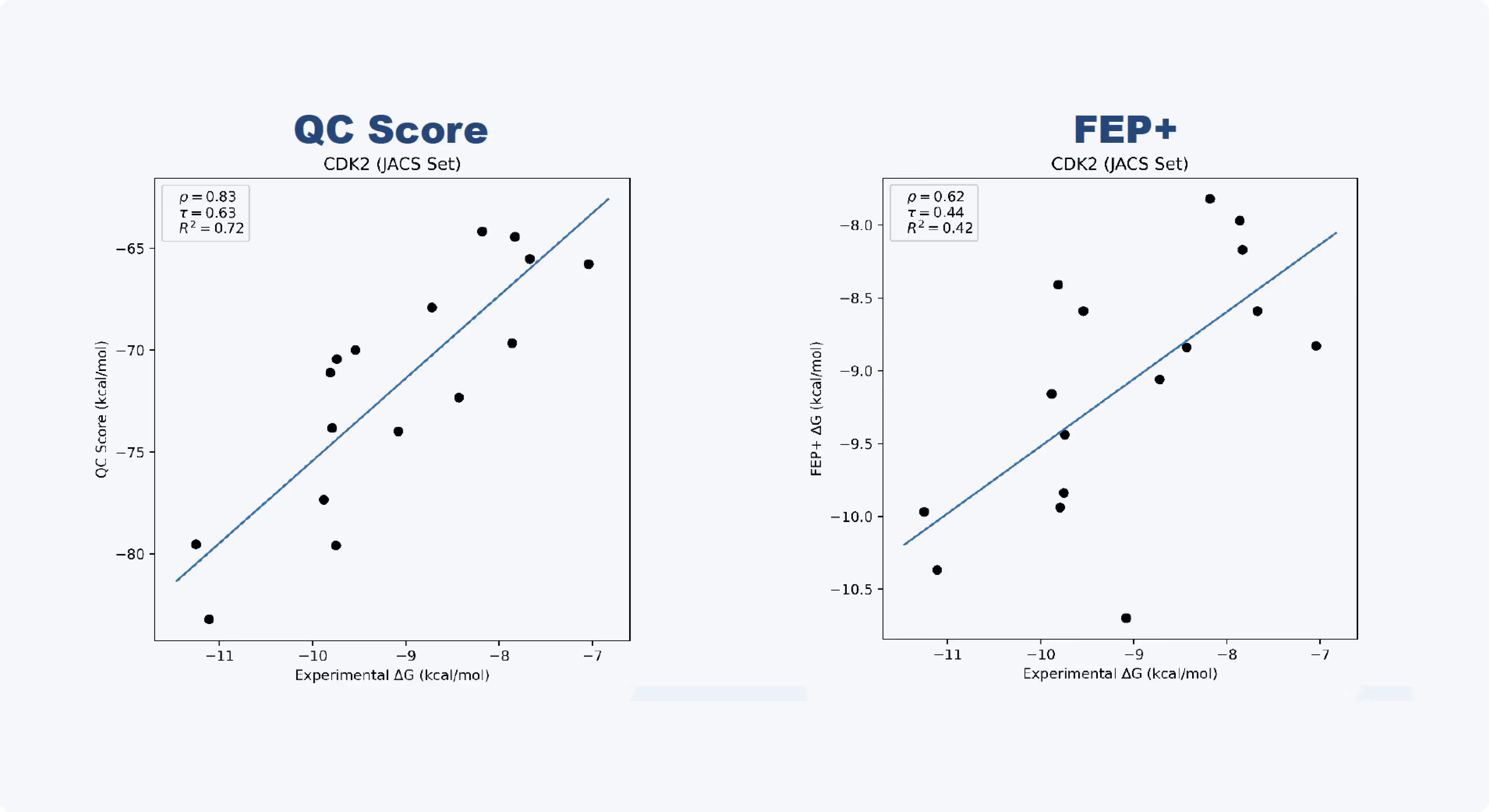
QC Score is a fully first-principles tool benchmarked against industry-standard methods and datasets.

GPU-Accelerated Quantum Chemistry
QC Score calculations complete in minutes per drug-like ligand on Promethium's GPU engine. Run scoring campaigns in parallel across multiple GPU instances, so your team can iterate on scoring cycles weekly instead of monthly.

First-Principles Accuracy, Zero Parameters
Fully ab initio with PCM solvation modeling. QC Score handles charged species, metal-containing active sites, PROTACs, molecular glues, macrocyclic inhibitors, antibody-drug conjugates (ADCs), and covalent ligands with the same first-principles treatment it applies to standard drug-like molecules.
.webp)
Use with InteractionMap
Export from QC Score into InteractionMap for four-component energy decomposition based on symmetry-adapted perturbation theory. QC Score identifies which residues dominate binding in context. InteractionMap reveals whether each contact is electrostatic, dispersive, or inductive. When the two methods diverge on a residue, that divergence reveals environmental dependence worth investigating.
Built for PROTACs, Molecular Glues, and Macrocycles
PROTACs, molecular glues, and macrocyclic inhibitors operate through ternary cooperativity, neomorphic interfaces, and bifunctional energy distribution. QC Score resolves these at the functional-group level, giving you the same atom-level insight on a 2,000-atom ternary complex that you get on a traditional small-molecule binding pocket.
How QC Score compares
Platform Capabilities
- Proprietary fragmentation-based quantum chemistry
- Advanced PCM solvation modeling
- Automated binding site cutout definition (3-10 Å)
- One-click export to InteractionMap powered by F-SAPT for functional-group analysis
- Cloud-native scalability for high-throughput
See the Physics Behind Binding
Computational chemistry teams at biotech and pharmaceutical companies use QC Score and InteractionMap for their lead optimization decisions.