
InteractionMap: Understand the Physics Behind Every Molecular Contact
InteractionMap decomposes interaction energy into electrostatics, exchange-repulsion, induction, and dispersion between user-defined functional groups, built on symmetry-adapted perturbation theory (SAPT). Combined with QC Score, it provides the complete picture: which contacts matter and the physical mechanism driving each one.
.webp)
Key Capabilities


The QC Score + InteractionMap Workflow

Identify Which Residues Matter (QC Score)
QC Score computes per-residue interaction energy within the full cutout electronic environment. Many-body polarization is captured, so the rankings reflect how residues contribute in their actual context, not as isolated pairs.

Understand Why Each Contact Matters (InteractionMap)
InteractionMap decomposes each interaction into its physical components. An electrostatic-dominant contact calls for H-bond optimization. A dispersion-dominant contact calls for hydrophobic bulk. The physics tells you which chemistry to apply.
.webp)

Uncover Hidden Environmental Effects (Divergence Analysis)
When QC Score and InteractionMap diverge on a residue, that divergence reveals environmental dependence. A contact that appears favorable in the many-body environment but repulsive in the isolated two-body decomposition tells you something important about the role of neighboring residues in stabilizing that interaction.

From Optimized Structures to Chemistry Decisions
QC Score generates an optimized binding geometry, and InteractionMap explains the physical interactions within that environment. Together they connect structural optimization directly to medicinal chemistry decisions.
Scalability and User Experience
Intuitive Interface
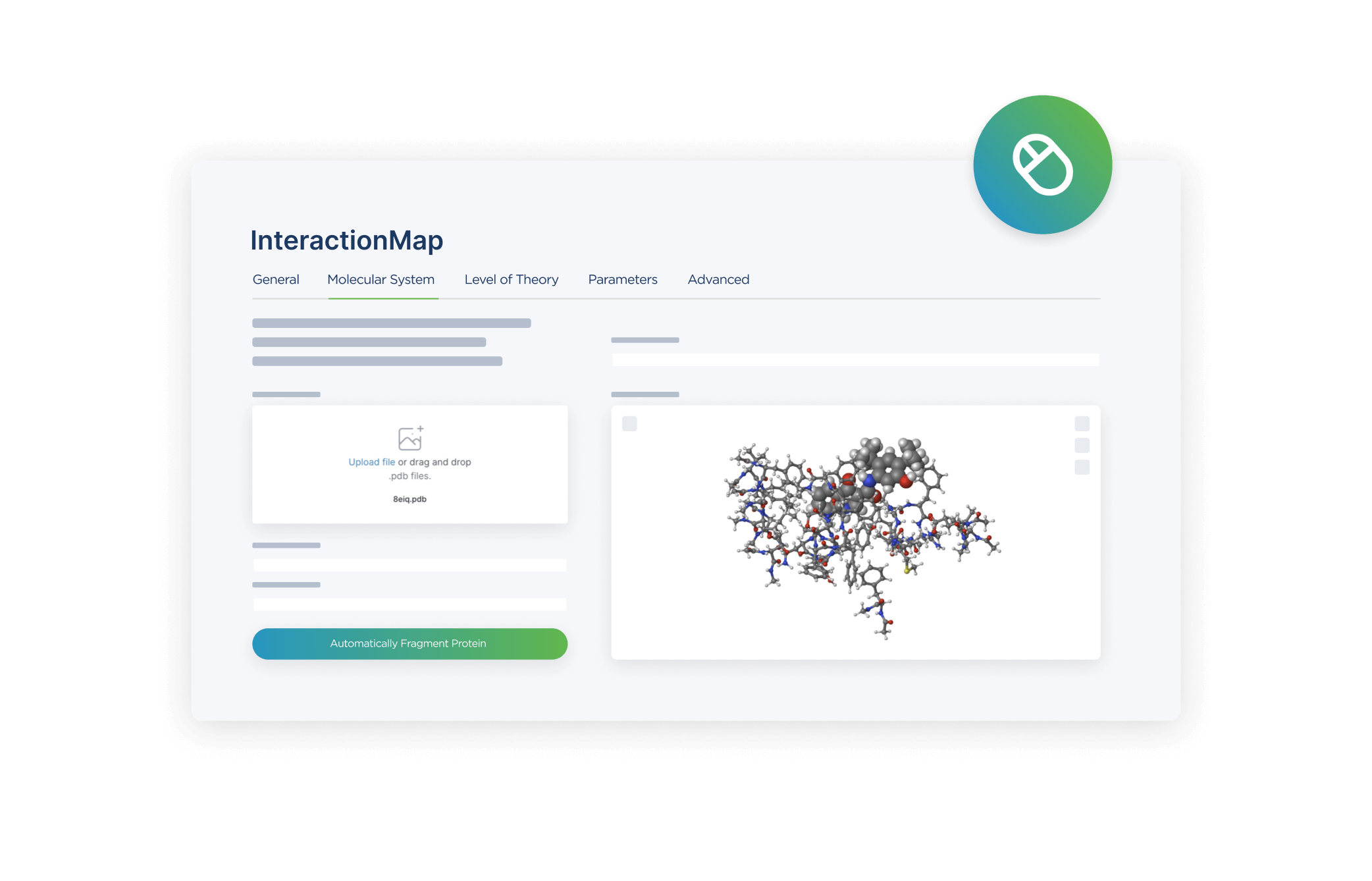
Set up and run InteractionMap analyses through Promethium's GUI or API. Automated structure preparation, one-click export from QC Score, and visual interaction maps get you from structure to actionable decomposition in a single session.
.webp)
Scalability
Promethium runs on AWS cloud infrastructure with batch processing for large compound sets. Whether you are decomposing interactions for a single complex or running InteractionMap across a 200-compound congeneric series, the platform handles the computational workload without manual queue management.
Frequently Asked Questions (FAQs)
Common questions about how InteractionMap works and what it tells you.

InteractionMap powered by F-SAPT (Functional-group Symmetry-Adapted Perturbation Theory) is a method integrated into Promethium that computes and analyzes the interaction energy between noncovalently bonded molecules. By computing these interactions in terms of fundamental physical contributions and then decomposing each component into pairwise contributions, F-SAPT provides detailed insights into the forces driving molecular behavior. This level of analysis is essential for optimizing molecular structures in drug design and materials science, leading to more effective and efficient research outcomes.
Promethium leverages advanced GPU technology to perform InteractionMap calculations with exceptional speed and efficiency. The platform's algorithms are optimized to fully utilize GPU capabilities, making complex quantum mechanical simulations significantly faster than with legacy software. This ensures that users can handle large datasets and large, complex systems.
InteractionMap powered by F-SAPT calculations on Promethium provide several detailed outputs:
- Interaction Energy: The total interaction energy of nonbonded complexes.
- Physical Contributions: Breakdown of the interaction energy into components like electrostatics, exchange-repulsion, induction, and dispersion.
- Fragment-Pair Contributions: Partitioning of interaction components into user-defined fragment pairwise contributions, offering granular insights into molecular interactions.
These outputs help researchers understand the specific forces driving molecular interactions, enabling targeted optimizations and more informed decision-making in their research.
Promethium features an intuitive graphical user interface (GUI) and API access, making it easy for both novice and advanced users to set up and execute F-SAPT calculations. The platform automates the preparation of protein-ligand complexes suitable for F-SAPT calculations. Results analysis of F-SAPT calculations on one or a series of related complexes is also automated, further streamlining the workflow. This user-friendly design ensures that sophisticated computational tools are accessible and efficient, enhancing overall research productivity.
InteractionMap powered by F-SAPT on Promethium is designed for researchers and scientists in fields such as drug discovery and materials science who need detailed and accurate insights into molecular interactions. Whether you are optimizing drug candidates or designing new materials, F-SAPT provides the advanced computational capabilities necessary to accelerate your research and achieve more effective outcomes.